
Why Early STEM Education Makes All the Difference?
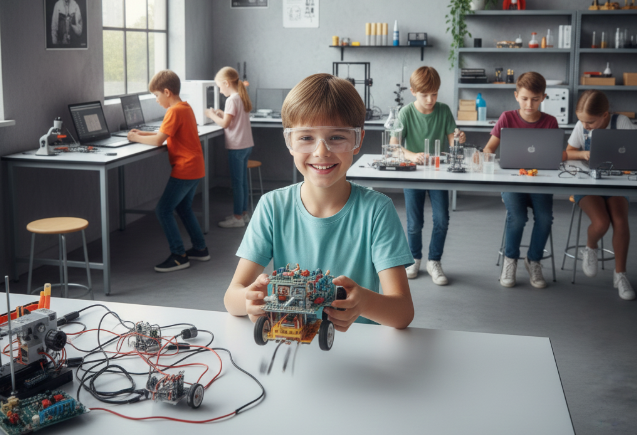
Children are naturally curious, they love asking questions like why is the sky blue, how does a fan work ? The natural curiosity is exactly why early STEM education is so powerful. When your kids are introduced to science, technology , engineering, and mathematics at a young age, they don't just learn facts, they learn how to think, experience and solve problems. Today a lot of parents and schools across India are realizing the importance of hands-on learning. With modern solutions like Robotic and AI labs setup, even young kids can experience fun, interactive and practical activities. The early experiences help build strong foundations for creativity and confidence.
STEM learning builds natural problem solvers
Kids who learn STEM Education are completely better at solving problems, not just in school but in everyday situations. When they code a small game, they also learn how to fix errors. These activities teach resilience, and children start believing that if they do any experiment and stay patient, they can find a solution.

STEM encourages hands-on experimental learning
Every child learns better when they can touch, observe and create. Early education gives them exactly that. Traditional classroom learning often relies on memorization. But STEM replaces this with:
- Fun experiments
- AI-based activities
- STEM challenges
- Interactive models
- Coding games
with organizations like STEMMANTRA, Schools can easily set up robotic and AI labs where kids can learn by doing.
Early STEM develops logical and critical thinking
STEM is not science; it's a way of thinking. For example, when a child programs a toy to follow a line, they have to adjust the direction, timing and speed. This sharpens logical thinking in a fun way.
When children solve a STEM task, they automatically:
- Think logically
- Look for patterns
- Analyse possibilities
- Compare results
- Think creatively
- Make decisions
STEM makes learning fun and enjoying
Subjects like science and math often seem difficult to kids but only because they learn them in STEM ways. With early education, the subjects become exciting and playful. When learning becomes enjoyable, children stay curious and motivated
Some examples:
- Learning math through building blocks
- Understanding electricity using simple circuits
- Learning coding through games
- Understanding physics by building a mini car
- Exploring AI through simple image-recognition tools
STEM prepares children for future careers
The world is rapidly moving towards technology for future jobs will require knowledge of
- Robotics
- Artificial Intelligence
- Automation
- Data Science
- Engineering
- Programming
- Digital Design
Introducing STEM early gives children a comfortable head start.
STEM helps children understand the real world
STEM concepts are all around us in our phones, cars, homes, hospitals and shops. When children learn STEM early, they understand how things work in daily life.
Practical examples include:
- Why lights turn on
- How fans spin
- How Alexa recognises your voice
- How mobile apps are built
- How solar panels produce electricity
Early education is not just an academic advantage, it's a life advantage. When kids explore STEM at a young age they become creative thinkers, confident problem solvers and curious learners.


