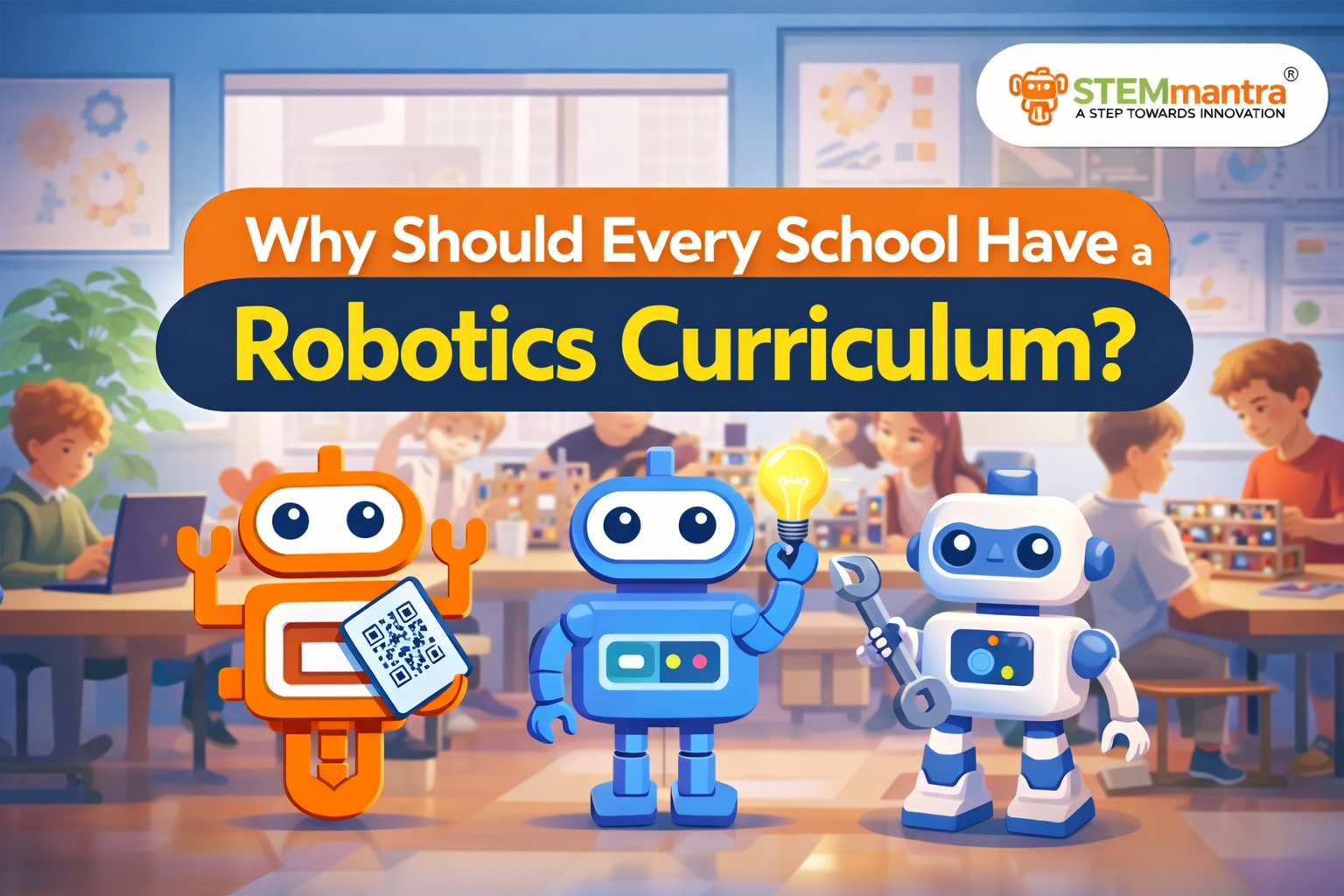
Why Should Every School Have a Robotics Curriculum?
When you hear the term robotics, you might instantly imagine human-like machines from movie characters that walk, talk and think like people. That image is exciting, but it is not what school robotics is all about. In real-world education, robotics means learning how sensors, motors, electronics, and basic coding work together to solve problems. A robotics curriculum in schools is one of the most powerful ways to prepare your kids for the future. It teaches them how to think, solve problems, and work with others.

Robotics is about thinking, not machines
Before you dig deep into robotics labs for schools, you need to understand the basics. School robotics is not about creating human-like machines; it's all about teaching students how systems work. It is basically no different from learning how a fan works, how a lift moves, or how a traffic lift changes. Robotics simply means putting all the ideas together into one hands-on activity. The goal is thinking skills, not fantasy.
Students use small kits made of:
- Sensors
- Wheels
- Motors
- Wires
- Controllers
- Simple code
These kits help students understand:
- How movement happens
- How decisions are made
- How signals travel
- How problems are solved

Why is traditional education no longer enough?
For many years, schools focused mainly on reading, writing, memorising and exams. These skills are very important, but the world has changed. Additional education often tells students what to think, and robotics education teaches them how to think. The 1st of this is one of the biggest benefits of robotics in education
Today’s world needs people who can:
- Solve new problems
- Adapt to change
- Use technology
- Create new ideas
Traditional education often tells students what to think. Robotics education teaches them how to think.
Build strong problem-solving skills
Robotics projects almost never work perfectly the first time. Something goes wrong, something doesn't move, something stops working. Instead of giving up, students learn to understand what failed, identify the problem, try a new solution, and even improve the design. This is our real problem solvers think. This is how engineers, doctors, designers and business leaders think. These habits are among the most powerful benefits of robotics in education.
Encourages Curiosity and Exploration
Robotics makes you curious. You begin asking, "What if I change this? What happens if I try that?" Instead of memorising answers, you start discovering them. This kind of curiosity is the foundation of innovation.
Above all, you need to know that a robotics curriculum in schools is not about creating human-like machines; it's about developing smart thinkers, problem solvers, and confident learners. The benefits of robotics and education extend far beyond technology; they shape how you think, learn, and grow. And a robotics lab for schools becomes a place where the future begins, one curious mind at a time. You might be afraid of technology because you never truly understand it, but robotics removes that fear. When you build and control a working system you realise you can even do this.
Read More:


