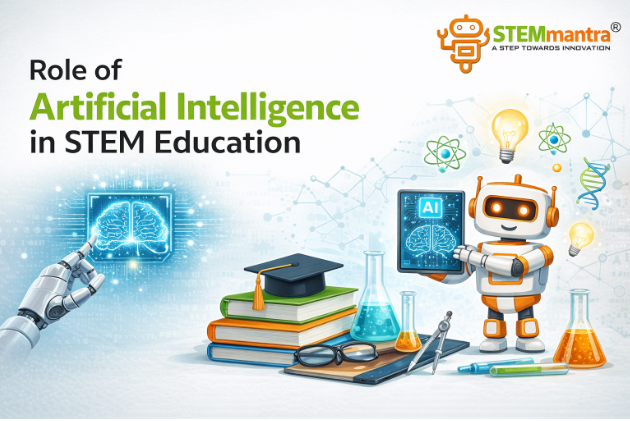
Role of Artificial Intelligence in STEM Education
When you hear the term artificial intelligence, you might imagine human-like machines from movie characters that talk and think like people. But in real education, AI is very different. It's not about science fiction movies on machines, it's all about smart computer systems that can analyse data, recognise patterns and help you learn better. In STEM education, artificial intelligence is becoming an important support system. It does not replace teachers; it does not replace students' thinking. Instead, it makes learning more customised.
AI makes learning more customized
In a traditional classroom 1 teacher teaches many students at the same time. But every student learns differently; some understand concepts quickly, while others need more time. With AI in STEM Education, you can track how a student is performing, identify weak areas, and suggest practice questions. This means you can learn at your own pace, without anyone feeling left behind or bored.
Understand the complex concepts
STEM subjects often include difficult topics such as algebra, physics, formulas, and data analysis. Sometimes reading from a textbook is not enough. AI-powered tools can provide step-by-step explanations and visual demonstrations. For example, instead of only reading about how a STEM works, you can use AI simulations to see the concept in action.
Encourages practical and project-based learning
STEM education focuses on practical learning. Artificial intelligence supports this by helping you experiment and explore. AI tools can analyse project results, suggest improvements, and predict possible outcomes. This encourages students to try new ideas without any fear. They learn through trial and improvement, which builds confidence.
Develops critical thinking skills
AI is not about giving ready-made answers. In good STEM education, AI tools are used to guide thinking and not replace it. You can learn how to ask the right questions, interpret data and evaluate results. For example, if you collect data from an experiment, AI tools can help them analyze it. But students still need to understand what the results mean.
Make coding technology more accessible
Artificial intelligence is connected closely to coding and programming. Well, you need to know AI in STEM Education is introduced to basic coding concepts. AI platforms can highlight code errors, explain them clearly, and suggest corrections. This makes technology less challenging and also more approachable for young learners.
So you must know that AI in STEM Education is growing every year. It brings customisation, practical learning, and real-world data analysis, and strong critical thinking skills to classrooms. AI does not replace teachers or human thinking; it enhances learning. When used correctly, artificial intelligence makes STEM education more engaging, accessible, and effective. In simple terms, AI helps you learn technology and understand it, use it wisely, and prepare you confidently for the future. And that is the true power of artificial intelligence in STEM education. The goal is to build smarter students, not fictional characters.
Also Read : Next-Gen STEM Learning: 5 Ways Tech Empowers Young Minds


